
Updated for 2026
Every student knows college is expensive, time-consuming, and demanding—but I think it’s the best time to build real-world skills and earn extra cash. In 2025, launching a side hustle no longer means waiting tables or working retail. With the right online platforms for student side hustles, you can turn your laptop into a 24/7 income stream that fits around your class schedule.
Whether you’re skilled in writing, graphic design, tutoring, or data tasks (searching, labeling, scrapping,..) there’s a legitimate gig waiting for you. Below, we explore the best online platforms for student side hustles complete with exact signup links, realistic earnings, and tailored pros and cons for college students.
Why College Students Should Leverage Online Side Hustles?
Traditional jobs often require rigid schedules-something most students can’t afford with back-to-back lectures, labs, and study sessions. Online platforms offer flexibility, remote access, and skill-building opportunities that boost both your resume and bank account. Plus, many require no prior experience, making them good head start for beginners.
This guide breaks down for you the best online platforms for student side hustles in 2026, based on legitimacy, ease of entry, earning potential, and flexibility around your responsibilities as a student;
No hype. No “get rich quick” promises. Just realistic options that actually work
Let’s dive into the top 7 platforms where students can earn cash online in 2026.
1-Fiverr
Sell Your Skills in Micro-Gigs. Fiverr is a global freelancing marketplace where you create “gigs” (gig is basically a service) that clients can purchase instantly or through custom orders.
How to get started:
Go to fiverr.com Click “Join” and sign up as a seller then complete your profile with basic infos and don’t forget to set at least 3 samples on your portfolio (for higher chances) here you re all set. Create your first gig (e.g., “I’ll design a minimalist resume for $20” or “I’ll build you a full optimized website”..) Set your own prices, delivery time, and description..
Earnings: Beginners often start at $5–$20 per gig. With reviews and optimized listings, many students earn $200–$800/month part-time!
Pros for students: No upfront costs, Work on your own schedule, Build a portfolio (very helpful for your future) while earning
Cons for students: High competition in popular categories (e.g., logo design, general writing..) Takes time to rank in search results plus the higher fees, Fiverr takes a 20% commission on each order you complete
Best for: Students with marketable digital skills (writing, design, editing, social media).
2-Upwork
Upwork is quite different than other options, Fiverr lets you create your services and then wait for clients to order but Upwork lets businesses or those seeking help to post their needs (writing, programming, marketing, design, data..) so freelancers can compete over these offers with proposals;
How to get started:
Visit upwork.com create a free account and complete your profile with relevant infos (include education, skills, and any past projects) Take Upwork’s readiness test (optional but helpful). Start applying to jobs with personalized proposals
Earnings: Entry-level jobs pay $5–$15/hour.
Experienced students report $15–$30/hour in niches like technical writing or Excel automation (this comes from a 3-6 months of experience with dedication)
Pros for students: Higher-paying long-term contracts possible Exposure to real business clients Builds professional credibility
Cons for students: Proposal limits for new users Approval for top-rated jobs can be slow Clients may prefer freelancers with extensive portfolios
Best for: Upperclassmen or students with prior internship/project experience.
smart move: to win on platforms like this build a sample page to show off your skills and work
3-Tutor.com / Chegg Tutors
Tutor or Chegg Tutors are online teaching platforms they simply connect teachers (in this case it’s you guys) with students and takes the middle-man part. You Simply Get Paid to Help Others Learn. So you need just to be good at what you offer, learners from all around the globe get on there in need to academic help in different subjects like math, science, exams prep, languages..
How you get started:
For Tutor.com: Apply at tutor.com/apply (requires subject mastery and background check) For Chegg Tutors: Sign up at chegg.com/tutors and complete a short subject quiz.
Earnings: Tutor.com: $10–$18/hour Chegg Tutors: $20/hour (paid per minute of active tutoring)
Pros for students: Leverage your current coursework Set your own availability (even late-night sessions) Reinforce your own understanding of material
Cons for students: Requires strong subject knowledge Background checks can take days Income depends on student demand (quieter during breaks)
Best for: STEM, business, and education majors with strong grades.
4-UserTesting
Earn by Sharing Your Opinions! UserTesting pays you to test websites, apps, and prototypes by completing short tasks and following clear instructions then providing verbal feedback, you typically help them with UX (improve user experience).
How to get started:
Go to usertesting.com Sign up and complete a sample test. Fill out your demographic profile to match with relevant tests. Earnings: $10 per 10–20 minute test.
Top users earn $50–$150/month by completing 5–10 tests weekly.
Pros for students: No special skills needed, just your honest opinion and tests can be done from your dorm room. Quick payouts (via PayPal in 7 days)
Cons for students: Inconsistent test availability Requires a quiet space and clear microphone. Not scalable as a primary income
Best for: Any student with reliable internet, a mic, and 15 free minutes.
5-Etsy
While known for handmade goods, Etsy is a goldmine for digital products like planners, trackers, resume templates, and study guides. Find a painful problem a category of people fight, think of the solution of that problem, productize it and sell and money will roll in. The good thing about digital products is that you you don’t worry about inventory or shipping. List once but you sell on repeat;
How to get started:
Visit etsy.com/sell Open a shop (one-time $0.20 listing fee per item) Create editable PDFs or Google Sheets using free tools like Canva or Google Workspace after you created your product you gonna list your it with strong keywords (e.g., “college student budget tracker”) Earnings: Digital products sell for $3-$25. With consistent marketing, students report $100-$1,000+/month passively.
ps: for some countries you will be asked to pay an amount of $12-14 upfront to open your shop
Pros for students: One-time creation = recurring income, Perfect for students who understand peer needs (e.g., job search trackers, professional resume template, habit trackers..) Builds entrepreneurial experience
Cons for students: Requires upfront design effort Marketing (Pinterest, TikTok) is essential for visibility Competition is rising in popular niches
Best for: Students with design or organizational skills who understand college pain points.
6-TaskRabbit
TaskRabbit connects you with local clients who need help with handy tasks like moving things, furniture assembly, we can say that TaskRabbit is a local service provider but these services are mostly physical.
How to get started:
Go to taskrabbit.com Sign up and complete identity verification Pass a background check (required) Set your service areas and hourly rate Earnings: $20–$50/hour depending on task type and location. Virtual tasks (like data entry) start around $15/hour.
Pros
Flexible local gigs (great for weekends). Build real-world client communication skills. Choose tasks that match your strengths.
Cons
Only available in select United States cities, physical tasks may interfere with study time Background check delays onboarding
Best for: Students in urban areas looking for in-person or hybrid gigs.
7-Substack / Buy Me a Coffee
This could be the best option for students why? cause you write and share content about what you love (this basically could be anything from social help, politics, art and creativity, finance and money..) attract like-minded audience then you monetize with subscription models!
If you enjoy writing, teaching, or sharing insights (e.g., side hustle tips, job search advice), you can build a paid newsletter or membership via Substack or Buy Me a Coffee.
How to get started:
Substack: Sign up at substack.com and create a free newsletter
Buy Me a Coffee: Register at buymeacoffee.com to accept tips or offer memberships Earnings: Vary widely. Top student creators earn $50–$500/month from loyal readers. Success depends on consistency and niche focus (e.g., “SaaS tools for college founders” “on-field skills for graduates’..).
Pros:
Develops personal branding and writing skills. Full creative control. Scales with your audience
Cons:
Requires consistent content creation. Growth takes time (3–6 months to gain traction). Not ideal for those uncomfortable sharing ideas publicly
Best for: Bloggers, aspiring founders, or students passionate about a specific topic.
Common Mistakes Students Make on These Platforms
- Creating multiple profiles and abandoning them
- Undervaluing their work
- Copying generic descriptions
- Expecting results in a few days
Consistency matters more than a talent does on the digital landscape.
Check top common mistakes students make with side hustles and how to avoid them
FAQs
What are the best online platforms for college students to make money?
The best online platforms for college students include Fiverr, Upwork, Etsy, Wyzant, Freelancer, and Shopify. These platforms offer flexible schedules, low entry barriers, and legit earning opportunities suitable for students.
Are online side hustle platforms legit for students?
Yes, many online side hustle platforms are legitimate. Students should avoid platforms that require upfront payments or promise guaranteed income. Legit platforms pay for real services, skills, or products.
How much can college students earn from online platforms?
College students can earn anywhere from $100 to $1,000 per month, depending on the platform, time commitment, and skill level. Skill-based platforms like freelancing and tutoring generally pay more.
What is the easiest platform for students to start a side hustle?
Platforms like Fiverr, Etsy (digital products), and tutoring sites are among the easiest for students to start, as they require minimal experience and offer flexible schedules.
Can students use multiple platforms at the same time?
Yes, but i highly recommend to start with one platform first to avoid burnout. Once comfortable, can expand to additional platforms
Final Tips for Choosing the Right Platform Not every platform suits every student.
Ask yourself these questions and answer honestly:
Do I prefer one-time gigs or recurring income?
Am I selling time (tutoring) or digital assets (Etsy)?
Do I want passive income or active client work?
Start with one platform that aligns with your skills and schedule. Track your hours and earnings—many side hustles evolve into full-time opportunities after graduation.
Your Side Hustle, Your Rules In 2026, the best online platforms for student side hustles offer more than just cash—they offer real-world experience, professional networks, and confidence. Whether you choose Fiverr for freelancing, Etsy for selling digital products, or UserTesting for quick cash, the key is to start small, stay consistent, and treat your hustle like a micro-business. And trust me this way you will grow!
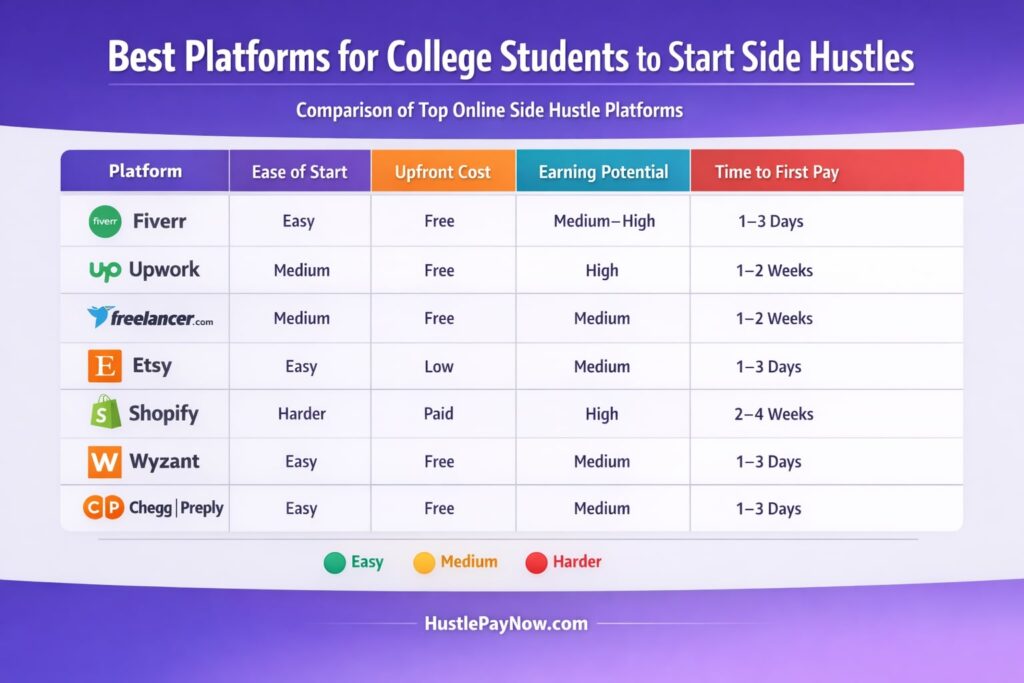
If you’re not sure which platform fits your situation, the comparison table below breaks it down by difficulty, cost, and how long it could take to get paid.
Remember: in this age the goal isn’t just to survive college—it’s to thrive during (and after) it. Pick a platform today, create your profile, and take your first step toward financial independence.
If you’re still deciding what side hustle fits you best, read this next:
👉 [15 Legit Side Hustles for College Students That Actually Pay in 2026]
how to start a side hustle in 2026 (step-by-step beginner guide)
Author Note
This article was written to help college students choose realistic, scam-free platforms that fit academic life — not to promote overnight success or any website!
if you have any concerning question/comment dont hesitate to share it and i’ll be happily responding : D