
You want to start freelancing but you have zero experience, zero portfolio, and maybe zero idea where to even begin. Sound familiar, right?
If you’re a beginner or someone completely new to online work, freelancing isn’t about getting rich overnight. It’s about turning downtime into income, building real-world skills, and creating a flexible side hustle that grows with you.
In this guide, you’re going to learn exactly what freelance beginner jobs are worth your time, where to find them, how to land your first client even with no portfolio, and how much you can realistically expect to earn. By the end, you’ll have everything you need to take your first step.
Let’s get into it.
What Is Freelancing and How Does It Work?
Freelancing simply means offering a service to clients and getting paid per project or per hour, without being a permanent employee. You work when you want, from wherever you want, and you choose who you work with.
As a freelancer, you’re essentially running a tiny one-person business. A client needs something done (a blog post written, a logo designed, their inbox managed) you do it, they pay you, and everyone moves on. Simple as that.
For students, freelancing is honestly one of the best ways to make money because:
- You set your own hours around your classes
- You can work from your dorm room or anywhere with Wi-Fi
- You don’t need a degree or years of experience to start
- You build real skills and a real portfolio while getting paid
The most common question beginners ask is: “But don’t I need experience first?” The short answer is no. You need proof you can do the work, and that’s something you can create yourself, which we’ll cover later.
Best Freelance Beginner Jobs With No Experience
This is the section you actually came for. These are the best freelance jobs for beginners, chosen because they’re easy to learn, have real demand, and don’t require a degree or years of practice to get started.
1. Freelance Writing
If you can write clearly and explain things well, freelance writing is one of the easiest entry points into freelancing. Clients need blog posts, product descriptions, email newsletters, social media captions, and more constantly.
- Skills needed: Good grammar, ability to research topics, basic understanding of writing for the web
- Realistic earnings: $15–$50 per article as a beginner, $100+ as you build experience
- Where to find gigs: Fiverr, Upwork, ProBlogger job board, LinkedIn
The best part? You can create writing samples on a free Medium account or Google Docs and use those as your “portfolio” even before your first paid client.
Our guide will help you decide between Fiverr and Upwork, check it from here
2. Graphic Design
If you have a good eye for visuals and you’re willing to learn tools like Canva or Adobe Express (both beginner-friendly), graphic design is a high-demand skill. Businesses need logos, social media graphics, presentations, flyers, and thumbnails constantly.
- Skills needed: Basic design sense, familiarity with Canva or Adobe tools
- Realistic earnings: $10–$50 per design as a beginner, $100–$300+ for logos as you improve
- Where to find gigs: Fiverr, 99designs, Dribbble, Instagram
Start by designing a few sample logos or social media posts for fictional brands. That’s your portfolio.
3. Social Media Management
Every small business knows they need to be on Instagram or TikTok, but most owners have no time to run their accounts. That’s where you come in. Social media management means creating content, scheduling posts, responding to comments, and growing an account.
- Skills needed: Familiarity with social platforms, basic content creation, Canva for graphics
- Realistic earnings: $200–$500/month per client as a beginner
- Where to find gigs: LinkedIn, local Facebook groups, cold outreach to small businesses, Upwork
This is one of the best beginner freelance jobs for students because you’re already using these platforms every day.
4. Video Editing
Video content is exploding and most creators like YouTubers, TikTokers, businesses don’t edit their own videos. If you can learn basic editing on tools like CapCut (free) or DaVinci Resolve (free), you’re in a market with serious demand.
- Skills needed: Basic video editing, understanding of pacing and transitions, subtitles
- Realistic earnings: $20–$100 per video as a beginner
- Where to find gigs: Fiverr, YouTube creator communities, Discord servers, Upwork
Edit a few sample videos using free YouTube footage and post them as your demo reel.
5. Virtual Assistant (VA)
A virtual assistant handles tasks that busy entrepreneurs and business owners don’t have time for scheduling, email management, data entry, customer support, research, and more. No specific technical skill required, just organization and reliability.
- Skills needed: Good communication, organization, basic computer skills
- Realistic earnings: $10–$20/hour as a beginner
- Where to find gigs: Upwork, Fiverr, Belay, Time Etc, LinkedIn
This is perfect if you’re not sure what skill to start with. VA work teaches you how businesses operate while you get paid.
6. Data Entry
It’s not glamorous, but data entry is one of the most beginner-friendly freelance jobs out there. Clients need spreadsheets filled, databases updated, forms processed, and information organized.
- Skills needed: Attention to detail, basic Excel or Google Sheets
- Realistic earnings: $8–$15/hour
- Where to find gigs: Upwork, Freelancer.com, Clickworker, Amazon MTurk
Great as a first gig to build reviews and get comfortable with client work.
7. Transcription
Transcription means listening to audio or video recordings and typing out what’s being said. It sounds simple because it is, but it requires focus and accuracy.
- Skills needed: Fast typing, good listening, attention to detail
- Realistic earnings: $10–$25/hour depending on speed and accuracy
- Where to find gigs: Rev.com, TranscribeMe, GoTranscript, Upwork
You can test and improve your typing speed for free at typing.com before applying anywhere.
8. Web Research
Businesses and entrepreneurs often need someone to gather information, competitor analysis, lead lists, market research, contact details. If you’re good at finding information online quickly, this is a surprisingly in-demand skill.
- Skills needed: Strong Google skills, ability to organize information clearly
- Realistic earnings: $10–$20/hour
- Where to find gigs: Upwork, Freelancer.com, LinkedIn
How to Choose the Right Freelance Skill (If You’re Not Sure Yet)
This is the question nobody talks about enough. Most guides just throw a list of skills at you and say “pick one” but how do you actually decide?
Here’s a simple framework to find the right fit:
Start with what you already do. You probably have more transferable skills than you think. Do you write well? That’s freelance writing. Are you the friend who always fixes people’s Instagram feeds? That’s social media management. Do you type fast and stay organized? Virtual assistant work is waiting for you. The best starting skill is usually the one that already feels natural.
Think about your setup. Video editing requires a decent laptop and free time to practice. Data entry just needs a computer and focus. Social media management can be done from your phone. Match your skill to your current tools and schedule, don’t wait until you have the “perfect” setup.
Consider the time-to-first-client curve. Some skills get you hired faster than others. Data entry and transcription have low barriers, you can be earning within days. Graphic design and video editing take longer to learn but pay more once you do. If you need money quickly, start with a simpler skill and build toward higher-paying ones over time.
Don’t overthink it. The biggest mistake beginners make isn’t picking the wrong skill.. it’s spending three weeks deciding instead of starting. Pick something that feels doable, commit to it for 60 days, and adjust from there. You can always add a second skill later once you have momentum.
A good rule of thumb: if you can imagine doing the work for two hours without getting bored, it’s worth trying.
How to Grow From Your First Gig to Consistent Income
Landing your first client is exciting. But the real goal is building something consistent, predictable income that grows month after month. Here’s how to make that transition:
Deliver so well that clients come back. Your best source of new work is your existing clients. Every project you complete is a chance to impress someone enough that they hire you again or refer you to someone else. Over-deliver on your first few projects even if you’re undercharging. The reviews and reputation you build in the first 90 days will do more for your income than any marketing strategy.
Raise your rates intentionally. After your first five reviews, raise your rates by 20–30%. After ten reviews, raise them again. Most beginners undercharge for way too long because they’re afraid of losing clients. In reality, raising your rates often filters out low-quality clients and attracts better ones. A higher price signals experience, even when you’re still building it.
Move toward retainers. One-off projects are fine to start, but monthly retainers are where stable income lives. A social media client paying you $400/month is worth more than four separate $100 projects, it’s the same money with far less time spent finding new work. After your second or third project with a client, pitch a monthly package. Something like “I could manage your Instagram every month for $X, would that be helpful?” is all it takes.
Build a simple portfolio page. Once you have two or three completed projects, create a basic portfolio. It doesn’t need to be a fancy website, a well-organized Google Doc, a Notion page, or even a Canva presentation works fine at the start. Include the project, what you did, and the result. Having something to link to makes every pitch and proposal dramatically more credible.
Track your income and hours from day one. This sounds boring but it’s genuinely important. Knowing your average hourly rate across all projects helps you identify which skills and clients are worth your time and which ones aren’t. A simple spreadsheet is enough. Many freelancers who plateau do so because they’re busy with low-paying work and don’t realize it until months later.
Freelancing isn’t a get-rich-quick path, but it is one of the most realistic ways for a student to build a real, scalable income from scratch. The students who succeed aren’t necessarily the most talented. They’re the ones who start, stay consistent, and keep improving one project at a time.
Where to Find Freelance Beginner Jobs
Knowing your skill is only half the battle. You also need to know where clients are looking to hire. Here are the best platforms for beginners:
Fiverr
Fiverr is hands down the best starting platform for beginner freelancers. Instead of applying for jobs, you create a “gig” -a service listing- and clients come to you. You set your price, describe what you offer, and wait for orders.
Best for: Writers, designers, video editors, VAs, social media managers Why beginners love it: Low barrier to entry, no bidding wars, you control your pricing
Tip: Start at a lower price to get your first few reviews, then raise your rates
👉 Start your Fiverr profile here
Upwork
Upwork is more competitive than Fiverr but the pay is generally higher. You apply for job postings that clients publish, and clients can also invite you directly. It takes longer to land the first client, but once you do, long-term contracts are common and achievable.
Best for: VAs, writers, developers, data entry, research Why it’s worth it: Higher budgets, long-term clients, professional reputation builder Tip: Write personalized proposals, never copy-paste a generic pitch
👉 Create your Upwork profile here
Freelancer.com
Similar to Upwork but with a larger volume of smaller projects. Great for data entry, writing, and design gigs. More competitive on price but good for building early experience.
PeoplePerHour
Popular in the UK and Europe. Works like a mix between Fiverr and Upwork. Good for writing, design, and marketing services.
Don’t underestimate LinkedIn. Many small business owners post freelance opportunities directly on LinkedIn, and cold outreach to local businesses through LinkedIn can land you clients faster than any platform, especially for social media management and VA work.
How to Get Your First Client With No Portfolio
This is the part most beginners get stuck on. You need experience to get clients, but you need clients to get experience. Here’s how to break the loop:
Create your own samples. You don’t need paid work to have a portfolio. Write three sample blog posts on topics in your niche. Design three sample logos for fictional brands. Edit a short video using free stock footage. These are real proof of your skills, nobody needs to know they were unpaid.
Start with a competitive rate. When you’re brand new, your first goal isn’t money it’s actually reviews. Price slightly lower than the competition to make saying yes easy for clients. Once you have five solid reviews, raise your rates.
Use your student status. Being a student is actually a trust signal with certain clients, especially small local businesses. Reach out to a local café, boutique, or restaurant and offer to manage their Instagram for a month at a discounted rate. One real client with real results becomes your best case study.
Reach out directly. Don’t just sit and wait for clients on Fiverr. Message small businesses on Instagram. Connect with entrepreneurs on LinkedIn. Join Facebook groups where your target clients hang out. A direct, personalized message beats a platform listing every time when you’re just starting out.
Ask for referrals early. Once you finish your first project, ask the client if they know anyone else who could use your services. Word of mouth is still the fastest way to grow as a freelancer.
How Much Can Beginner Freelancers Actually Earn?
Let’s be honest about the numbers, because a lot of blogs will overpromise here, and lot of these are just hype.
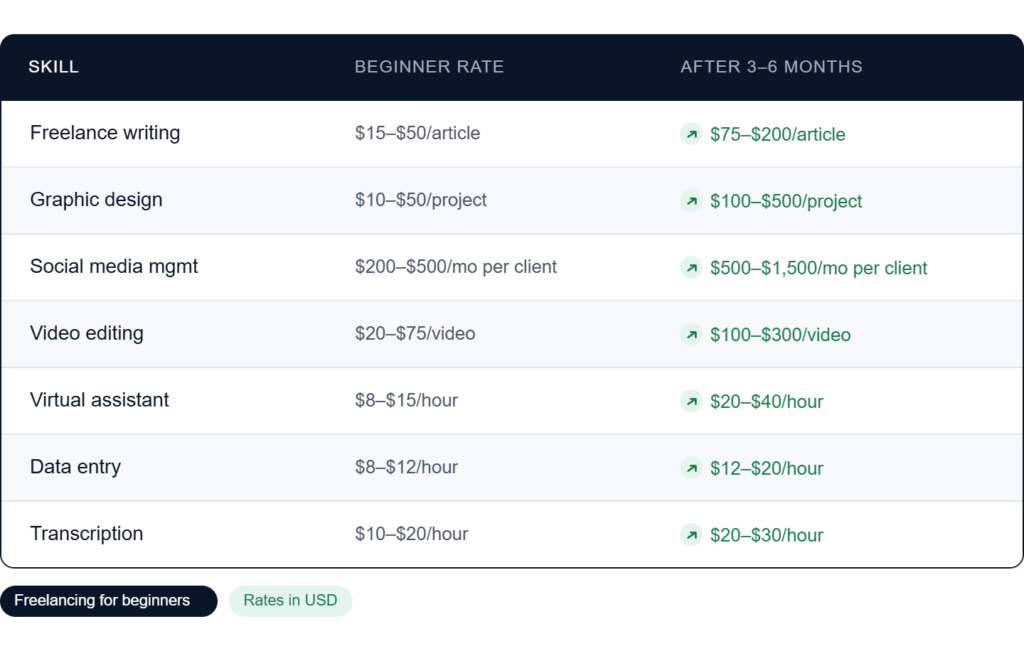
As a beginner working part-time (10–15 hours/week), realistically expect to make $200–$600/month in your first few months. That number grows quickly once you have reviews, a portfolio, and repeat clients.
For a deeper breakdown of student earning potential, check out our guide on How Much Can Students Earn From Online Jobs.
How to Set Up Your Freelance Profile
Your profile is your storefront. A weak profile means no clients, no matter how good your skills are. Here’s what matters:
Profile photo: Use a real, clear, friendly photo. Smiling helps. Clients are hiring a person, not a logo.
Bio/description: Lead with what you do and who you help. “I help small businesses grow their Instagram following through consistent, engaging content” is ten times better than “I am a social media manager with passion for creativity.”
Your first gig title: Be specific. “I will write a 1,000-word SEO blog post for your website” outperforms “I will write content” every single time.
Pricing: Research what other beginners charge and price competitively, not the cheapest, but fair for your level.
Packages: Offer three tiers (basic, standard, premium) even as a beginner. It makes you look more professional and gives clients options.
Common Mistakes Beginner Freelancers Make
Learning from other people’s mistakes is free, so you need to pay attention to these:
Underpricing too aggressively. There’s a difference between competitive pricing and working for almost nothing. Clients who pay very low rates are often the most demanding. Price low to get started, but have a plan to raise rates after your first few reviews.
Trying to do everything. “I do writing, design, video editing, VA work, and data entry” sounds versatile but actually makes clients trust you less. Pick one skill and become known for it. You can always expand later.
Disappearing after the project. Following up with clients after delivery -asking if they need any revisions, checking in a few weeks later- is how one-time clients become long-term ones.
Giving up after rejections. Your first ten proposals might all be ignored. That’s normal. Every successful freelancer has a story of rejection. The ones who make it are simply the ones who kept going.
Not communicating clearly. Clients don’t mind delays or problems, they mind silence. Keep clients updated, ask questions before starting (not halfway through), and always confirm deadlines in writing.
For more mistakes to avoid, check out Side Hustle Mistakes College Students Make.
Start Today And Not Tomorrow
Here’s the truth: you could spend another week reading guides, watching YouTube tutorials, and “preparing”, or you could spend the next two hours creating your Fiverr profile and publishing your first gig.
The second option will teach you more than any guide ever could.
Pick one skill from this list. Create two or three samples. Set up your profile. Publish your first gig. That’s it. That’s the whole starting point.
You don’t need to be perfect. You just need to start.
👉 Create your free Fiverr account and post your first gig today
And if you’re still figuring out which online money-making path fits you best, check out our full guide on 15 Legit Online Jobs for Students With No Experience , it covers everything from surveys to full remote jobs, so you can find what works for your schedule and skills.
Disclosure: Some links in this article are affiliate links. If you sign up through them, we may earn a small commission at no extra cost to you. We only recommend platforms we genuinely believe in.
FAQs: Freelance Jobs For Beginners
What are the best freelance jobs for beginners with no experience?
The best freelance beginner jobs with no experience are freelance writing, virtual assistant work, data entry, transcription, and social media management. These skills have low barriers to entry, don’t require a degree, and have consistent demand from clients on platforms like Fiverr and Upwork. If you’re a complete beginner, start with one of these before moving to higher-skill options like graphic design or video editing.
Can I do freelance beginner jobs from home?
Yes, almost all freelance beginner jobs are fully remote. Whether you’re doing data entry, writing blog posts, managing social media, or working as a virtual assistant, everything happens online. All you need is a laptop and a reliable internet connection. This is exactly what makes freelancing one of the best options for students who want to earn money without leaving campus.
What are the easiest freelance jobs for students?
The easiest freelance jobs for students are data entry, transcription, and web research, because they require minimal training and you can start almost immediately. If you want something with higher earning potential that’s still beginner-friendly, freelance writing and virtual assistant work are great next steps. The key is picking one skill and focusing on it rather than trying to do everything at once.
Fiverr or Upwork which is better for freelance beginners?
For complete beginners, Fiverr is the better starting point. You create a gig, set your price, and wait for clients to come to you, no bidding, no proposals. Upwork is more competitive but pays higher rates and is better for landing long-term contracts. The ideal strategy is to start on Fiverr to build your first reviews, then expand to Upwork once you have a portfolio to show.
Are there freelance jobs for beginners that actually pay well?
Yes. social media management, video editing, and freelance writing can all pay well even as a beginner once you have a few reviews and solid samples. Social media management in particular is one of the highest-paying freelance beginner jobs because clients pay monthly retainers rather than per project. As a student working part-time, hitting $500–$1,000/month within your first few months is a realistic goal if you stay consistent.