
Let’s cut through the noise:you don’t need a degree, a fancy portfolio, or years of experience to start freelancing. You just need a skill, a platform, and a simple system to land your first client, then repeat the process and scale.
If you’re a beginner or someone completely new to online work, freelancing isn’t about getting rich overnight. It’s about turning downtime into income, building real-world skills, and creating a flexible side hustle that grows with you.
In this guide, I’ll walk you through exactly how to make money freelancing for beginners, step by step. No fluff. No fancy promises. Just a clear, actionable roadmap that’s worked for thousands of beginners worldwide.
Why Freelancing Actually Works for Beginners (Yes, Even Students)
Most people think freelancing is for “experts.” Let me tell you the truth: That’s never true.
Here’s why it’s a good choice for beginners
-Low barrier to entry: You can start with free tools and zero upfront costs
-Flexible hours: Work around classes, shifts, or study sessions
–Skill compounding: Every project makes you faster, smarter, and more valuable
–Global access: Platforms like Upwork and Fiverr accept clients and freelancers from 150+ countries
Real talk: Freelancing won’t replace a full-time job in month one. But as a side hustle? It’s one of the most reliable ways to earn $50–$300/month while building a skill that pays for years.
our guide about Freelance Beginner Jobs will help you find your best gig with 0 experience, check it whenever you want!
Now let’s begin
Step 1: Pick a Beginner-Friendly Skill (No Experience Needed)
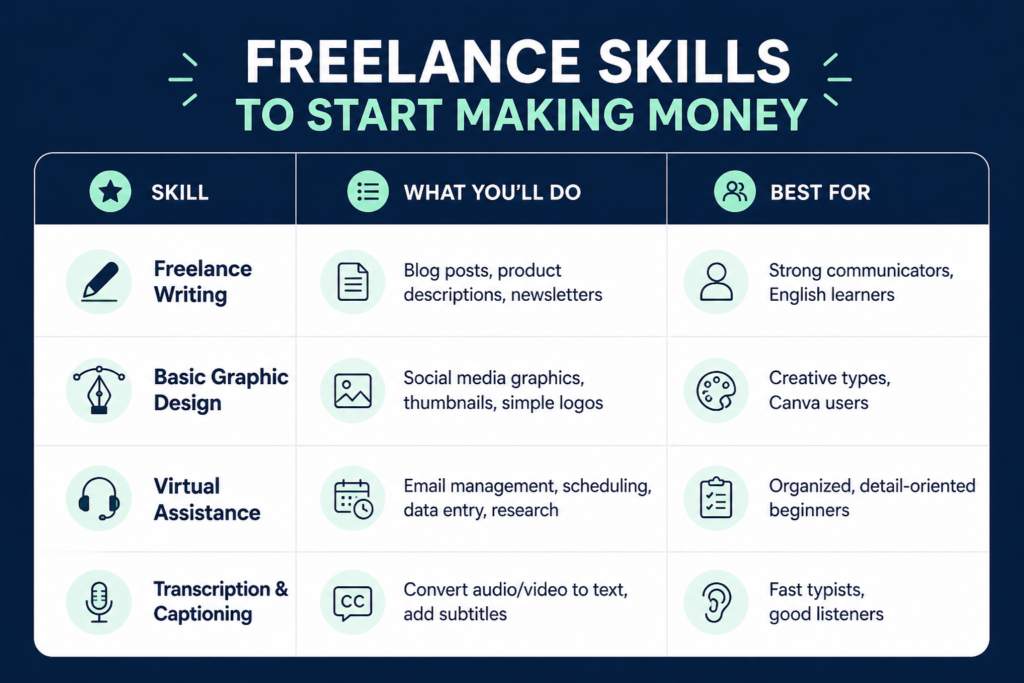
At the beginning don’t go after advanced skills or fancy stack. Start with skills that are in high demand, easy to learn, and highly repeatable.
Top 4 Beginner-Friendly Freelance Skills
How to Learn Fast (Free Resources)
Writing: HubSpot Academy (free content marketing course)
Design: Canva Design School + YouTube tutorials
VA/Ops: Notion tutorials, Trello basics, Gmail filters
Transcription: TypeFaster (free typing trainer), Rev.com guidelines
💡Pro tip: Don’t spend months “studying.” Learn the basics, then learn by doing. Your first paid gig will teach you more than any free course, from here things compound faster!
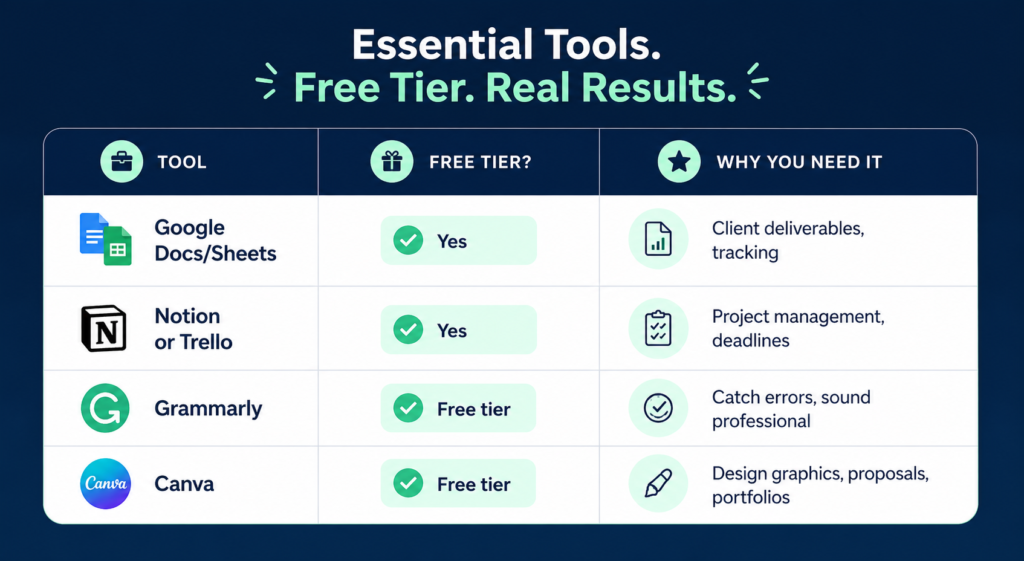
Step 2: Set Up Your Free/Low-Cost Starter Kit
Being simple and deliver results will outweigh fancy but procastinate, as a beginner your main focus must be simple but works . Here’s the lean toolkit that actually works for freelancing beginners
Step 3: Choose the Right Platform for Your First Gig
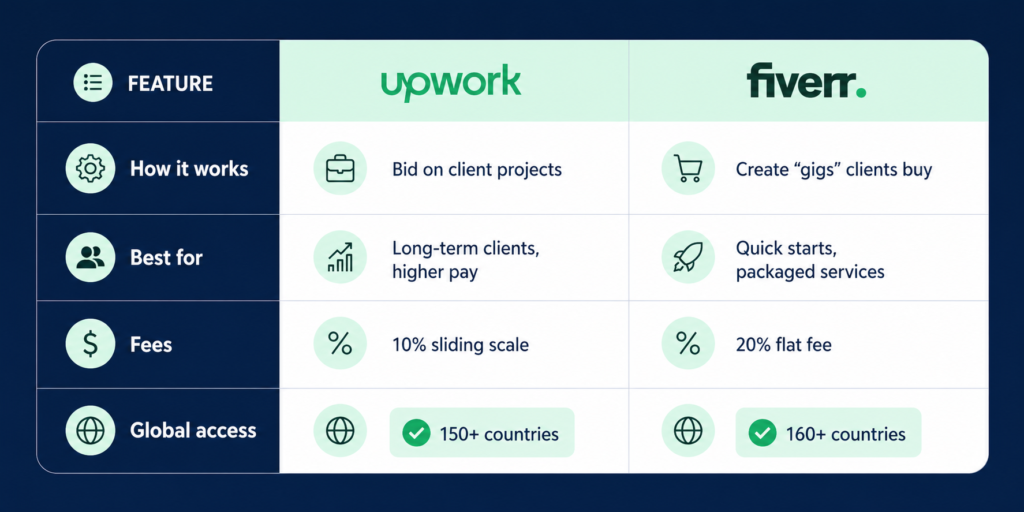
Two platforms dominate the beginner space: Upwork and Fiverr. Here’s how to pick:
Which Should You Start With?
Choose Upwork if you want to build relationships, negotiate rates, and aim for $15–$30/hr within 3 months
ChooseFiverr if you want to package your skill into a clear offer (e.g., “I’ll design 3 Instagram posts for $15”) and get your first sale faster.
This comparison guide will help you choose: Fiverr vs Upwork which is better for beginners
Step 4: Land Your First Client (Even With Zero Portfolio)
This is where most beginners quit. Don’t.
You don’t need past clients to prove you can deliver. You need proof of skill.
✅How to Build a “Spec Portfolio” in 48 Hours
-Pick 3 sample projects (e.g., write a 500-word blog post, design 3 social graphics, organize a mock spreadsheet)
-Save them as PDFs or link them in a free Google Drive folder
-Add a simple header: “Sample Work- [Your Name]”
you may wanna check 10 AI side hustles for beginners to start
#📝Profile Optimization Checklist
Professional photo (clear, friendly, well-lit)
Headline: “Beginner [Skill] Freelancer | Fast Turnaround | Detail-Oriented”
Overview: 3 short paragraphs: who you help, what you do, why choose you
Portfolio: Upload your spec samples
Availability: Set to “More than 30 hrs/week” (adjust later)
Proposal Template (Copy-Paste Friendly)
Hi [Client Name],
I saw you’re looking for [specific task]. I’ve worked on similar projects and can deliver [clear outcome] by [date].
I’ve attached 2 samples that match your needs. I’m happy to do a quick test task or jump on a 10-min call to discuss details.
Looking forward to helping you get this done!
Best, [Your Name]
NB: First goal isn’t profit. It’s a 5-star review. Price slightly below market ($10–$20 for first 2–3 gigs) to build momentum and eventually gain traction
Step 5: Get Paid & Avoid Beginner Scams
How Payments Work
Upwork: Hourly (tracked via app) or fixed-price (released in milestones)
Fiverr: Funds held until order complete → withdraw via PayPal, Payoneer, or bank
Withdrawal time: 5–14 days depending on method & country
🌍 Global tip: If PayPal isn’t available in your region, Payoneer works in 150+ countries and integrates directly with both platforms.
🚩 Red Flags to Avoid
1-“Pay me to get hired” or “buy my training first”
2-Requests to communicate/pay outside the platform
3-Vague deliverables (“just make it look good”)
4-Unrealistic promises (“earn $500/day with no skills”)
Rule: If it feels sketchy, walk away. Platforms protect you when you stay on-site.
Realistic Earnings: What You’ll Actually Make
Let’s set expectations straight:
if you need money for quick surveys side hustles can help you, check them.
Freelancing compounds. Your first $20 gig teaches you how to deliver. Your fifth $50 gig teaches you how to negotiate. By month six, you can see real results because this is where massive growth shows up.
Ready to Start? Your Next 3 Steps
1-Pick one skill from Step 1 and spend 2 hours learning the basics
2-Create your spec portfolio (3 samples max)
3-Sign up on one platform and send 5 tailored proposals this week
Freelancing is not about talent or fancy portfolio, it’s about systemizing your process and being consistent.
FAQs: how to make money freelancing for beginners
Start by creating a complete profile with a professional photo, a clear bio, and a portfolio, even if it’s sample work you created to demonstrate your skills. Choose one or two service categories to specialize in (writing, design, data entry, etc.) rather than offering everything. Bid on smaller, lower-competition projects first to build your review score, since clients heavily rely on ratings. Write personalized proposals that address the client’s specific problem rather than copying a template. Once you land 3–5 projects with positive reviews, you can gradually raise your rates and go after bigger contracts.
Earning $100/day as a freelance beginner is achievable once you have a few reviews under your belt. For example, if you charge $25/hour, you only need 4 billable hours. Realistic paths include: writing 2–3 articles at $40–$60 each, doing virtual assistant work for 3–4 hours, completing small graphic design tasks, or handling social media for a local business. The fastest route is to pick a skill that’s in high demand (copywriting, video editing, web design) and target clients outside the major freelance platforms, like small business owners on LinkedIn or local Facebook groups , where competition is lower and budgets are often higher
$3,000/day is a realistic ceiling for experienced, highly specialized freelancers, not a starting point. Professionals who reach this level typically offer high-value services like B2B copywriting, conversion optimization, fractional CMO work, or software development for enterprise clients. They usually get there by niching down deeply, building a strong portfolio with measurable results (e.g., “increased client revenue by 40%”), and charging project-based fees rather than hourly rates. As a beginner, treat this as a long-term goal: focus first on mastering one skill, collecting testimonials, and raising your rates every 3–6 months as your results improve.
Yes. $1,000/month is one of the most attainable early milestones for beginner freelance writers. At $0.10/word (a common entry-level rate), that’s about 10,000 words, or roughly 5–8 blog posts. At $0.15–$0.20/word (achievable after a few months), you’d need even less. To get there faster: pitch content agencies and marketing teams directly (they hire regularly), specialize in a niche like SaaS, finance, or health (niche writers earn more), and create a simple portfolio site with 3 writing samples. Most writers who commit consistently hit the $1k/month mark within 60–90 days.